For most homes in Nepal, a German Shepherd is the first choice for a guard dog, with the Doberman and Rottweiler close behind. The Belgian Malinois suits experienced handlers; the Tibetan Mastiff, Bhote kukur and Kangal suit farms and big compounds. As of October 2026, puppies cost about Rs 10,000–350,000, by breed. Training matters more than the breed.
Which dog is best for home security in Nepal?
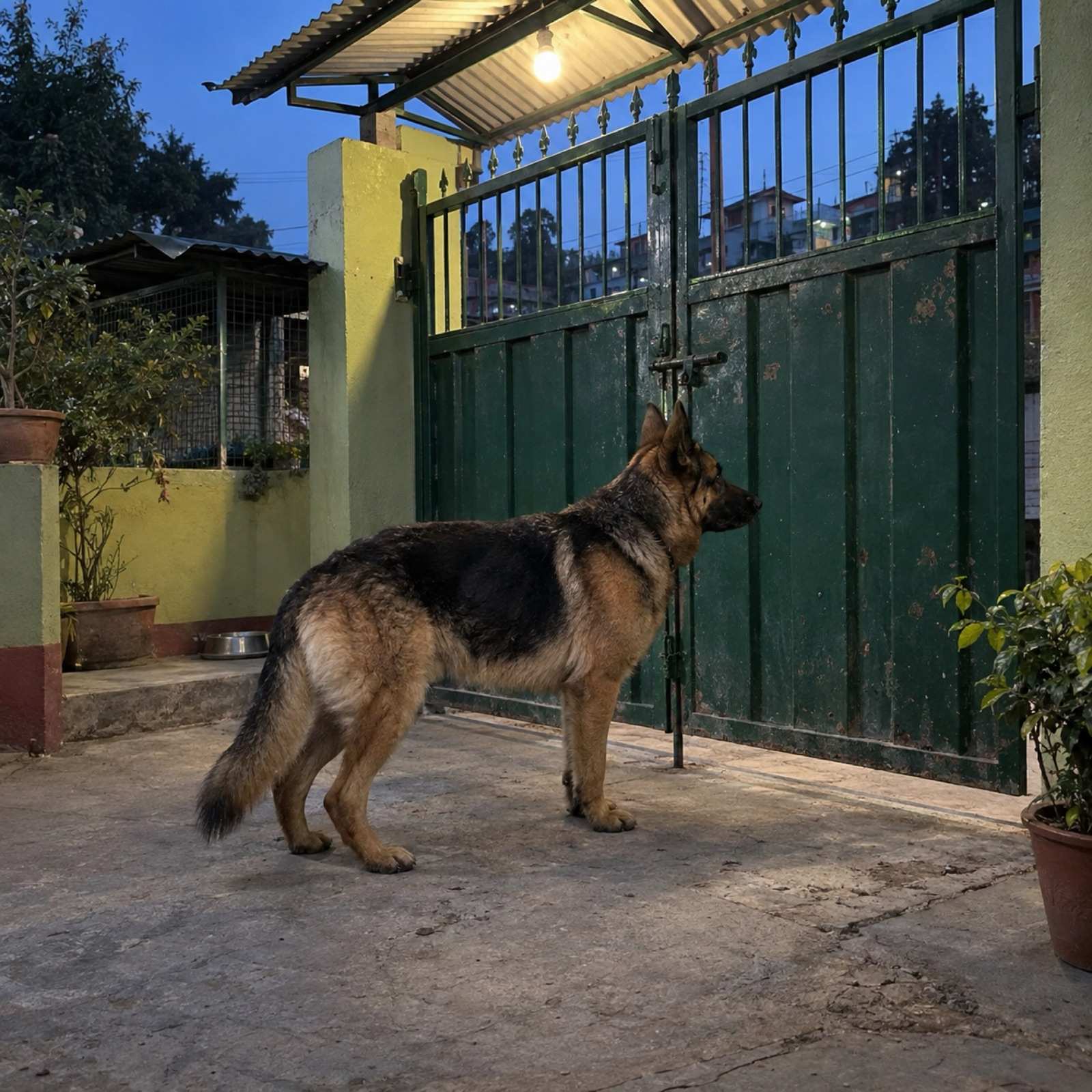
For a house in Kathmandu, start with a German Shepherd. It is alert, learns fast, and copes with cold winter nights and, with shade and water, the summer. A Doberman or a Rottweiler is the next choice. The Belgian Malinois is a police-style worker for experienced handlers. The Tibetan Mastiff, the Bhote kukur (Himalayan sheepdog) and the Kangal are flock guardians: they suit a farm or a large compound more than a town house.
Weather matters for every breed. In Kathmandu, afternoons average about 29°C from May to August, and nights drop to about 3–5°C in December and January (Department of Hydrology and Meteorology figures). Heavy coats suffer in summer, and the Terai is hotter still. Short coats need a warm, dry bed in winter.
| Breed | As a guard | Adult weight | Coat and Kathmandu weather | Exercise and training | Puppy price in Nepal (Oct 2026) |
|---|---|---|---|---|---|
| German Shepherd | Loyal, confident, protective; a police breed | 23–41 kg | Medium double coat. Fine on winter nights; shade and water May–August | High. Learns fast; needs work every day | Rs 15,000–95,000 |
| Belgian Malinois | Intense and fast; police and protection work | 18–36 kg | Short coat. Copes with summer better than heavy coats | Very high. For experienced owners only | Rs 70,000–150,000 |
| Rottweiler | Self-assured and territorial; barks mostly to alert | 36–61 kg | Short black coat. Keep it in shade on hot afternoons | Moderate. Early socialisation is a must | Rs 25,000–120,000 |
| Doberman | Alert, athletic, protective; a police breed | 27–45 kg | Short, smooth coat. Give it a warm bed on winter nights | High. First-time owners need a trainer | Rs 20,000–90,000 |
| Tibetan Mastiff | Guards at night; barks at sounds | 30–70 kg | Heavy double coat built for high altitude. Hard going in summer | Moderate. Independent; slow to obey | Rs 150,000–350,000 (1 source) |
| Bhote kukur (Himalayan sheepdog) | Guards flocks and property; wary of strangers | 23–41 kg | Long, thick double coat. Fine in winter; needs shade in summer | Moderate. Independent; needs early handling | Rs 10,000–35,000 |
| Kangal | Flock guardian from Turkey; needs land | 40–60 kg | Short, dense double coat. Needs shade in summer | Moderate. Independent; needs a big fenced area | No Nepal price found |
The prices are what sellers asked for puppies, as of October 2026. We checked them on 5 October 2026 at PriceInNepal, Indreni Pet Zone and ImNepal, plus a 2023 Rising Nepal report and a 2024 classified ad for the Bhote kukur. The sources disagree. Shop and classified prices sit at the low end. ImNepal lists “bloodline” and imported puppies far higher: Rs 250,000 and more for a German Shepherd, and Rs 800,000 and more for a Tibetan Mastiff. A trained adult guard dog costs more than any puppy in this table.
Some sellers call the Bhote kukur a “Himalayan mastiff”. The Tibetan Mastiff is a heavier, different breed that costs far more, so ask which one you are buying. We found no Kangal for sale in Nepal with a price.
Guard dog or protection dog?
People use the words loosely, but they are different jobs.
- Watchdog. It barks when a stranger comes to the gate and stops when you say “quiet”. Most homes need only this.
- Guard dog. It watches a place: a house, a farm, a factory yard. It barks, holds the boundary and patrols the fence line. It stays calm with the family and with the visitors you let in.
- Protection dog. It guards a person. It stays at the handler’s side, acts on command and stops on command. It needs a mature, steady dog, long training and a handler who trains with it. It is not the right choice for most families.
Why the breed alone is not enough
A breed gives a dog its size and its instincts. Training decides whether it is safe at your gate. An untrained guard breed may bark all night, ignore you, or go for a guest. A fearful dog is more likely to bite than a confident one.
Training goes in order, and each stage needs the one before it:
- Socialisation. As a puppy, the dog meets people, children, bikes, traffic and other dogs, calmly and often.
- Obedience. Sit, down, stay, come, heel and quiet, at home and outside. Nepal Police puts every dog through a 3-month basic obedience course before any police work (Nepali Times, 2011).
- Alert. The dog barks at a stranger at the gate and stops on command.
- Guard. The dog holds a gate or a boundary and patrols it.
- Handover. The family learns the commands, so the dog obeys them and not only the trainer.
Guard work should never start before obedience is solid. The American Kennel Club (AKC) makes the same point about the Rottweiler: early training and socialisation turn its territorial instinct into something useful.
Which breed for a family home, and which for a farm or factory?
- A family house in town. Choose a German Shepherd or a Doberman. Both learn fast, and the AKC rates both well with young children. A Rottweiler suits a family with time for early socialisation; the AKC marks it “better with supervision” around children, as it does the Tibetan Mastiff.
- A farm, factory, warehouse or building site. With land, a strong fence and few visitors, a Bhote kukur, Tibetan Mastiff or Kangal guards on its own, mostly at night. Where a guard patrols with the dog, a German Shepherd or Belgian Malinois works better, because it takes commands from a handler.
- The Belgian Malinois. It needs a job. The AKC says it is not a dog to leave in the backyard, and daily walks are not enough. Without daily training and hard exercise, it becomes hard to live with.
- A flat. None of these breeds suits a flat.
Is a Husky good for security?
No. Huskies are popular in Nepal, but they are friendly with almost everyone. The AKC rates the Siberian Husky 1 out of 5 as a watchdog and calls it an “indifferent” one. A Husky may howl at the gate, but it will not guard it. Its thick coat also struggles in a Kathmandu summer. Keep a Husky as a family dog, and choose a guard breed for the gate.
Living safely with a guard dog
- The gate. Fit a gate that latches, and a wall or fence the dog cannot jump, climb or dig under. Close it every time.
- Visitors and delivery riders. Put the dog in its kennel run or on a lead before you open the gate.
- Children. Never leave a guard dog alone with children, your own or visiting ones. Teach children not to tease it through the gate.
- Neighbours. Kathmandu houses stand close together, so a dog that barks all night causes trouble. The Tibetan Mastiff is a night guard that barks at sounds. Teach “quiet” early.
- Health. Keep the rabies vaccine up to date; ask your vet for the schedule. A dog in pain is more likely to snap, so see your vet if its temper changes.
- The family. Every adult in the house should know the commands and use the same words.
Guard dog training at Supreme Pet Home
K9 trainers have worked at Supreme Pet Home in Kapan, Kathmandu, since 2023. Every dog starts with an assessment, and the assessment sets the plan. We train dogs from 8 months to 5 years old, and a vet checks each dog before stage 1. Every adult in the house attends the handover, so the dog obeys the family as well as the trainer.
We also have trained guard dogs, priced by breed: message us on WhatsApp at +977 971-4624151 to ask which dogs are ready. Guard dog training for your own dog starts at Rs 60,000, after a Rs 1,500 assessment. See K9 for the programme, and Train for obedience and puppy classes.
- PriceInNepal: Dog price in Nepal (1 May 2026; checked 5 Oct 2026)
- Indreni Pet Zone: breeds and puppy prices (checked 5 Oct 2026)
- Indreni Pet Zone: Belgian Malinois in Kathmandu (16 Sep 2025; checked 5 Oct 2026)
- Indreni Pet Zone: Rottweiler puppy price in Kathmandu (checked 5 Oct 2026)
- ImNepal: Dog price in Nepal, 2026 guide (checked 5 Oct 2026)
- The Rising Nepal: Coming from Sikkim to breed pure breed dogs (18 Nov 2023; checked 5 Oct 2026)
- Admandu: Bhote kukur puppy listing, Lalitpur (7 Feb 2024; checked 5 Oct 2026)
- American Kennel Club: German Shepherd Dog (checked 5 Oct 2026)
- American Kennel Club: Belgian Malinois (checked 5 Oct 2026)
- American Kennel Club: Rottweiler (checked 5 Oct 2026)
- American Kennel Club: Doberman Pinscher (checked 5 Oct 2026)
- American Kennel Club: Tibetan Mastiff (checked 5 Oct 2026)
- American Kennel Club: Siberian Husky (checked 5 Oct 2026)
- Wikipedia: Himalayan Sheepdog (Bhote kukur) (checked 5 Oct 2026)
- Wikipedia: Tibetan Mastiff (checked 5 Oct 2026)
- Wikipedia: Kangal Shepherd Dog (checked 5 Oct 2026)
- Wikipedia: Kathmandu climate table, WMO and Department of Hydrology and Meteorology data (checked 5 Oct 2026)
- Nepali Times: K-9 unit, Nepal Police dog training (9 Sep 2011; checked 5 Oct 2026)